
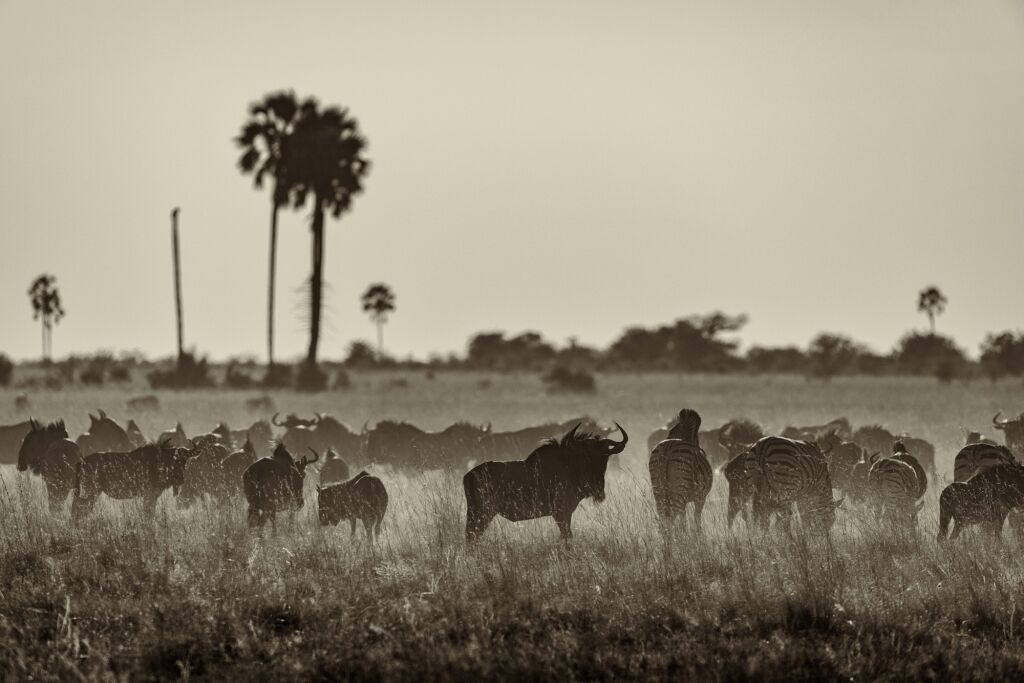
If you can only come to Jack’s Camp once, choose the dry season, April to October, for the salt pans themselves, and the green season, November to mid-April, for the zebra. The two things that exist only when the crust is dry are quad biking across it and sleeping out on it; the two things that exist only when it is not are the arrival of about 30,000 zebra and wildebeest and the flamingos breeding on the water. Everything else the camp is known for, the meerkats, the Bushman walks, the night drives and the Kalahari’s stranger carnivores, is there in both.
Updated 21-Oct-2026

Photography courtesy of Natural Selection
Jack’s Camp is nine tents on the edge of the Makgadikgadi, one of three camps in a one-million-acre private reserve, and its own page says, fairly, that there is no wrong answer to the season question, only two different camps. That is true and not much help to anyone holding a calendar. So here is the same information arranged the way a person actually decides: what you get, what you give up, and what does not care either way.
What does the dry season give you that the green season cannot?
The pans. From April to October the Makgadikgadi is what the name promises: white salt to the horizon, mirages doing their work in the middle distance, and nomadic herds reduced to a line of dots on the far side of it. Two activities depend on that surface being hard enough to drive on. Guided quad biking takes you out across the crust, and the sleep-out puts a bedroll on it, under a sky with nothing in the way. Neither is offered once the rain has turned the pans to grassland, for the reasonable reason that a quad bike in a shallow lake is not an activity so much as an incident.
Game and night drives, the walks with the Bushmen and the meerkats all run in the dry months too, so you are not trading away the camp’s daily rhythm to get the salt. You are trading away the animals that come with the water, which is the next section.
What does the green season give you that the dry season cannot?
Company. From November to mid-April rain turns the pans to grassland, and about 30,000 zebra and wildebeest arrive between November and March, an event Natural Selection, which runs the camp, calls Africa’s second-largest mammal migration. It is a quieter affair than the Serengeti’s: nobody else is out there watching it with you. In March and April the flamingos breed on the pans, and the migratory birds are in. The camp’s own page files its helicopter flights over the pans, doors on or off, and its horse riding under the green season as well. The horses are offered on the grounds that this is how the earliest explorers crossed the place, which is true, though the explorers did not have a 270-square-metre tent with a plunge pool to come back to.
What you give up is the salt. The white crust, the mirages and the quad bikes belong to the dry months, and sleeping out on the pans goes with them.
What stays the same whichever you choose?
Most of what makes the place peculiar. The habituated meerkat colony is there year-round; the meerkats are still wild, they have simply stopped minding you. The walks with the Bushmen continue in both seasons. Night drives go out once the desert crust has cooled, and that is when the animals most safaris never see do their best work: brown hyena (Natural Selection puts the world population at about 8,000), aardwolf, bat-eared fox, honey badger, aardvark and the black-maned Kalahari lion, with gemsbok, springbok and black-backed jackal for daytime company. None of these consults a calendar.
Neither does the camp. The nine tents, the 1820s officer’s mess table, the pool pavilion and the 24-hour solar power are the same in April as in November. If you want to check on the neighbourhood before you commit, Natural Selection runs a 24-hour high-definition camera at the waterhole in front of camp, which is one way of settling a family argument.
Salt or grass: the short version
| Season | Months | Only in this season | What you give up |
|---|---|---|---|
| Dry | April to October | Guided quad biking across the salt crust; sleeping out on the pans; the white salt and the mirages | The zebra and wildebeest arrival; the breeding flamingos |
| Green | November to mid-April | About 30,000 zebra and wildebeest (November to March); flamingos breeding (March to April); migratory birds; heli safaris and horse riding as the page lists them | The salt crust itself; the quad bikes; the sleep-out |
| Either | Year-round | Meerkats; Bushman walks; game and night drives; brown hyena, aardwolf, aardvark, bat-eared fox and black-maned Kalahari lion | Nothing |
So which is it?
Ask yourself what you will tell people about afterwards. If the answer is a landscape, the salt, the flat white nothing and a bedroll in the middle of it, come between April and October. If it is animals in numbers, come between November and March, and aim for March or April if the flamingos matter. If it is the meerkats, it does not matter, and you may stop reading.
And if the zebra are the point, the camp’s own advice is good: pair Jack’s Camp with Leroo La Tau on the Boteti River, where the same migration comes down to drink. We have written about Leroo La Tau before, and the rest of our Botswana lodges are there if the Makgadikgadi is one stop of several. Tell us which season you are leaning towards and we will tell you what we would do with the other one.

