
Xugana Lagoon has water when the calendar says the Delta is dry because it is a permanent water site, widely regarded as the finest in the whole Okavango, and permanent is the important word. Xugana Island Lodge sits on it, which is why its world is one of channels and reflections whatever the month happens to be.
Updated 12-Nov-2026
To understand why the lagoon stays full you have to go a long way upstream, to a river that behaves unlike almost any other.
Where does the Okavango’s water come from?
The highlands of Angola. The river rises there, runs south into Botswana, and then does something rivers are not supposed to do: it gives up on the idea of an ocean. Instead of finding a coast it spreads its water across the sands of the Kalahari until the desert has drunk its fill. What remains is a wilderness of freshwater lagoons, channels and islands in the northwestern corner of Botswana, over 15,000 square kilometres of it by the usual reckoning, the largest inland delta in the world and a UNESCO World Heritage Site.
It is a rather poetic outcome for a river that lost its way. Most deltas are a river’s farewell to the land. This one is a river deciding to stay.
Why does a river that never reaches the sea produce a permanent lagoon?
Because once the water has nowhere left to go, it has to rest somewhere. The lodge’s owners put it neatly: in the heart of the Delta, water finds a place to rest in the Xugana Lagoon. Some parts of the Okavango are seasonal, filling and emptying as the Angolan floodwaters arrive and retreat, and in the dry months the water pulls back and open grassland appears where there was floodplain. Xugana is not that kind of place. The lagoon is one of the Delta’s permanent water sites, the places that hold water through the whole cycle, and it is spoken of as the most beautiful of them.
That is the whole answer, really. The calendar governs how much of the Delta is wet. It does not govern Xugana Lagoon, which is wet regardless.
What does “permanent” change about a stay?
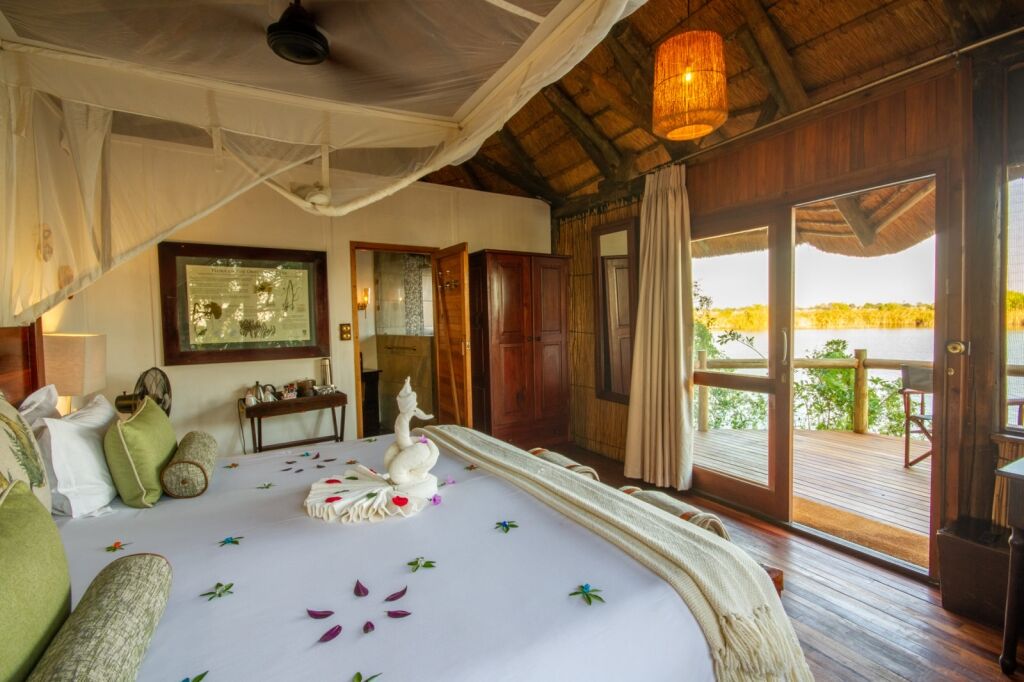
Almost everything, starting with how you move. An island lodge in the Delta is approached by water, so the bush is approached by boat. The days are measured in lagoon light. The room has the lagoon at the door, the bar is under thatch, dinner is one long table under the trees, and the sound you fall asleep to is not tyres on gravel but something considerably wetter.
Walking features too. The lodge’s own pictures show guests on foot under the big trees, which is what an island does for you: it gives you ground to stand on with water on every side, and the animals that want that ground have to come by the same route you did.
From the air, which is how the lodge’s page first shows it, the lagoon is a dark, settled thing among the channels. It looks like what it is: the place the river stopped.
Does this tell you when to go?
No, and that is deliberate. This post is about where the water comes from and why Xugana keeps it. When the flood arrives, how far it reaches and which months suit which activities is a different question with a different answer, and we have kept it for its own post rather than muddle the two. What you can take from this one is simpler: whichever month you choose, Xugana Lagoon will have water in it, and the lodge will be sitting on the edge.
Why does this matter when choosing a Delta camp?
Because the Okavango is Africa’s largest oasis and most of it is seasonal. A camp on seasonal water has to tell you, honestly, that the boats depend on the flood. A camp on the best-watered corner of the Delta does not have to tell you anything of the sort. Some claims are easy to make. This one is easy to check.
If the idea of a river that never reaches the sea has got hold of you, our longer piece on exploring the Okavango Delta covers the rest of the system, and the Botswana pages list the other camps on it, permanent water and otherwise. We are happy to help you work out which kind you want.

